

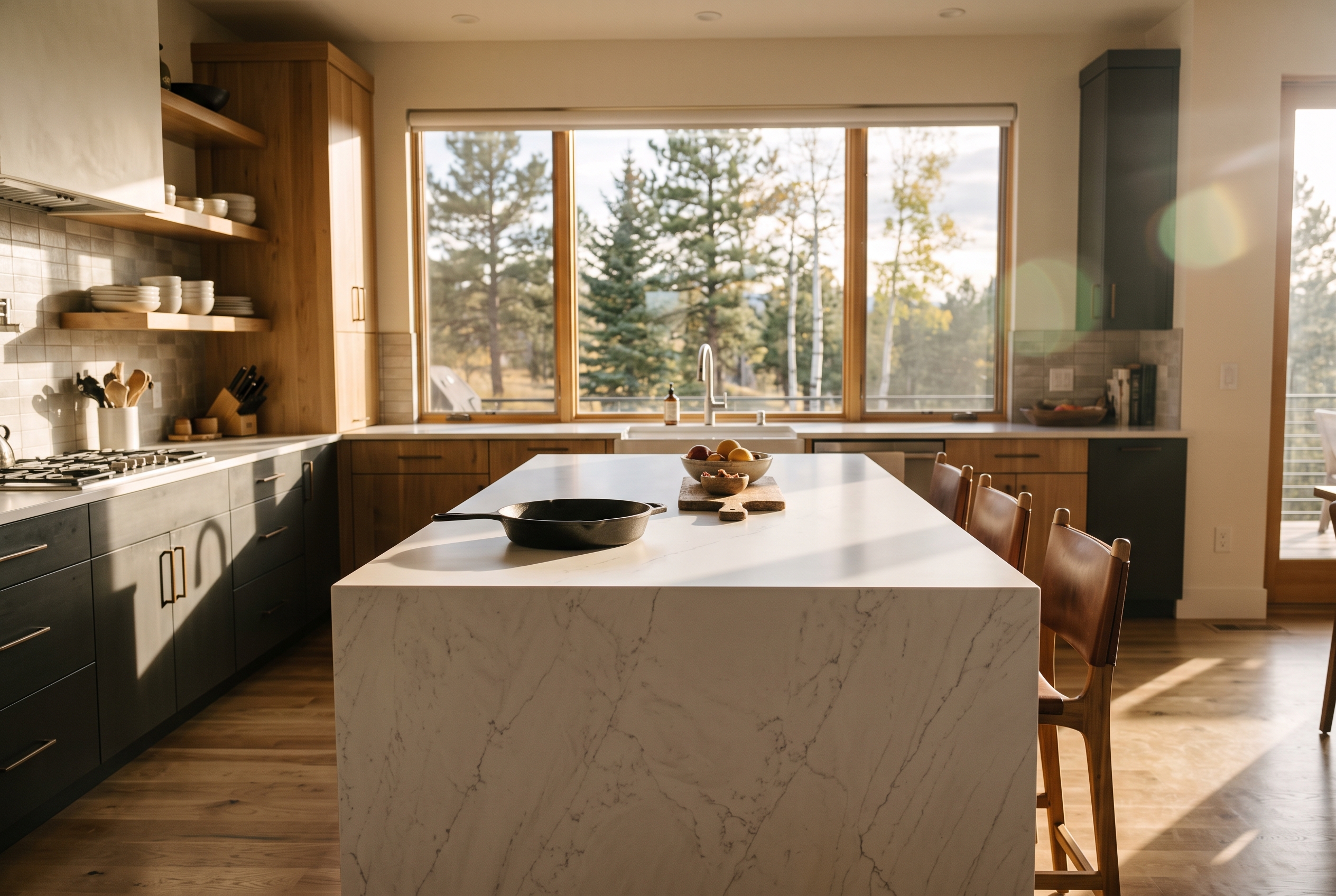
Porcelain is one of the strongest countertop choices for a kitchen where hot pans, strong sun and stains are the worry. A slab fired that hard doesn't scorch, fade or soak anything up, and it never needs sealing. What it asks of you is care at the edges, where a thin slab can chip. It also asks for planning up front, because the edge profile you choose and how the slab is cut matter more than with quartz or granite.
| Your kitchen | Porcelain? | Why |
|---|---|---|
| Sunny, south or west windows | A strong fit | Won't fade or yellow |
| Busy cook, hot pans | A strong fit | Takes pans set down after cooking |
| Outdoor kitchen or patio bar | A strong fit | Frost and sun resistant |
| Heavy cast iron, tight corners | Yes, with eased edges | Corners and edges take the knocks |
| Thick, chunky edge profile | Mitered edge instead | Thin slabs limit edge shapes |
What a Porcelain Countertop Is
A porcelain countertop is a large, thin slab of porcelain, the same dense fired material as porcelain tile, made big enough to cover a counter with few or no seams. Slabs usually come about 12 millimeters thick, roughly half an inch, or 20 millimeters, about three-quarters of an inch. The stone, marble, concrete or wood look is fired onto the surface.
Porcelain behaves the way it does because it takes in almost no water; a dense slab absorbs about a tenth of a percent. That's why it doesn't stain, doesn't need sealing and doesn't mind freezing. It's also light for its size, so it works on walls, backsplashes and fireplace surrounds as well as counters.
Is Dekton Porcelain?
Not quite, though it behaves much the same way. Cosentino calls Dekton an ultracompact surface and tests it to the same standards used for porcelain and ceramic tile. It shares porcelain's strengths: it takes in about a tenth of a percent of water, passes the industry's frost and thermal-shock tests, and is made for counters inside and out.
Dekton comes in 8, 12, 20 and 30 millimeter thicknesses, and the 12- and 20-millimeter slabs are the usual kitchen counters. We carry it in lines such as Dekton Natural, Pietra Edition, Onirika and Stonika, so for most kitchens the choice between Dekton and another porcelain is a matter of look, thickness and price.
Where Porcelain Countertops Shine
Porcelain countertops shine where kitchens are hardest on a surface: under hot pans, in strong sun, against stains and under knives. Each strength comes from the same dense, fired body, and each has a simple habit that keeps it that way.
Hot Pans and Heat
Porcelain doesn't scorch or discolor under a hot pan, because there's no resin in it to burn, so a skillet or a saucepan can come straight off the stove onto the counter. Cosentino makes one exception for its thinnest slab: 8-millimeter Dekton needs a trivet under hot objects.
Two limits apply to every slab. Keep open flame and very high direct heat off it, such as a grill's firebox or a torch. And the cooktop should sit on its own mounting, with its hot metal frame clear of the stone, which an installation done right takes care of.
For appliances that run for hours, such as a slow cooker or an electric griddle, a trivet is a good habit on any countertop. On porcelain it matters most near the edges, where heat and a knock can meet.
Sun by the Window and Outdoors
Porcelain holds its color in direct sun, because the color is fired into the slab, with no resin to yellow. That matters at our altitude, where the sun is strong and a counter under a south or west window sees it for hours a day. The same stability is what lets porcelain go outdoors.
Finish decides how a sunny counter feels. A polished slab throws glare at midday, while honed and matte finishes soften the glare in a sun-filled kitchen. For a counter that faces a big window, look at samples at the time of day the sun hits it, and lean toward a matte or textured finish.
Stains and Sealing
Porcelain never needs sealing, because wine, oil, coffee and turmeric sit on top of a dense slab instead of soaking in. A wipe takes them off, and household cleaning products don't harm it.
A stain that soap won't lift has a specific fix by type. Use an acidic cleaner for limescale and rust, and a solvent such as acetone for grease, ink or candle wax. Juice and cola come off with a mild oxidizer such as diluted hydrogen peroxide. A polished finish shows marks and smudges more than a matte one, so match the finish to how you cook.
Scratches and Knives
Porcelain is harder than steel kitchen knives, so everyday use doesn't scratch it. Cutting on it dulls the knife and can leave gray metal marks, which clean off with a mild cleanser.
Use a cutting board, the same advice that goes for quartz and granite. High-gloss slabs and ceramic knives are the pairing to avoid: a ceramic blade is hard enough to mark a glossy face. Rough-bottomed pottery and cast iron dragged across a polished slab can leave faint marks too, so lift pans instead of sliding them, and choose matte if you want everyday scuffs to disappear.
Chips, Edges and the Printed Pattern
A porcelain slab's face is tough, but a sharp knock on an edge or a corner can chip a thin slab, and that's the limitation to plan around. Cosentino tells Dekton owners to avoid knocks on exposed corners, edges and bevels, and the same goes for any porcelain.
The pattern adds a second consideration. On many porcelain slabs the design is fired onto the face, so a chip on the edge can show the body color underneath. Some lines carry the color or the veining through the body, which hides a chip better.
The risk is managed in the design, before anything is cut:
- an eased edge, slightly rounded, which is usually included in the price
- a mitered edge, where a strip of the same slab wraps the edge so the pattern continues and the counter looks thicker
- radiused corners where people walk past an island or a peninsula
- a slab with color through its body where an edge sees knocks
Day to day, the habits are simple. Set heavy pans down on the field of the counter, away from the edge, keep a board under cast iron and stoneware, and keep stools from banging the island's corners.
Porcelain vs Quartz, Granite and Quartzite
If sun, heat or an outdoor setting is your main concern, porcelain is usually the better choice. If you want a thick, sculpted edge and the most forgiving surface for a busy family with sharp corners, quartz or a natural stone can suit you better. All four are surfaces we install, so the choice is about your kitchen.
Quartz is crushed stone bound with resin, which makes it non-porous like porcelain but more sensitive to heat. Cambria, whose quartz we carry, recommends a hot pad or trivet under pots and pans, slow cookers and air fryers, and notes that hitting edges around a sink or dishwasher can chip quartz too.
If a quartz counter will sit in strong sun all day or go outdoors, check that line's own care and warranty terms first, a check porcelain doesn't need. Granite and quartzite are natural stone with variation no factory can copy, and granite handles heat better than quartz but asks to be sealed every few years.
| Material | Heat and sun | Edges | Upkeep |
|---|---|---|---|
| Porcelain or Dekton | Pans after cooking; won't fade | Thin; eased or mitered | No sealing |
| Quartz | Trivets for hot pans | Thick, many profiles | No sealing |
| Granite | Handles heat well | Thick, shaped edges | Seal every few years |
| Quartzite | Handles heat and sun | Hard; thick edges | Sealing |
A 12-millimeter porcelain slab weighs about 6 pounds a square foot, against about 15 for 3-centimeter quartz. That makes porcelain the easier slab for walls and full-height backsplashes, and lighter on a long run of cabinets.
Thickness, Finish and Edge Choices
For most kitchen counters, 12-millimeter porcelain on full support is the standard choice, and 20 millimeters is the pick for islands, overhangs and anywhere a heavier edge suits the look. Thinner slabs are for walls and backsplashes, and they're the ones that want a trivet under hot pans.
Finishes change how a slab lives:
- polished, the most reflective, which shows smudges and glare in a sunny room
- matte or honed, soft-looking, which hides fingerprints and everyday scuffs
- textured, with a stone-like feel, for a natural look and outdoor counters
An eased edge is the standard on porcelain, and a mitered edge builds a thick look from the same slab. Book-matched slabs mirror the veining across a seam or down a waterfall end, so the pattern reads as one piece of stone.
How Porcelain Countertops Are Installed
Porcelain countertops go in on cabinets that are level, fixed and solidly supported, and the slab is templated on those installed cabinets. A thin slab can't bridge a gap the way a thick stone can, so support decides how well it lasts.
- The base cabinets are set level and fastened, with every leg on the floor.
- The counters are templated on the installed cabinets.
- The slab is cut on water-cooled saws or CNC machines, with rounded inside corners at sink and cooktop cutouts.
- A plywood subdeck or a strong frame goes under the slab, with support at regular spacing and under every seam.
- The slab is set and seamed, and the sink and cooktop are fitted.
Caesarstone's fabrication rules show the standard. It calls for a 5/8-inch plywood subdeck under its 13- and 20-millimeter surfaces over larger areas, front-to-back support every 20 to 24 inches, and at least a 3/8-inch radius at every cutout corner. Cracks in a thin slab usually trace back to a long seam or a gap with nothing under it.
The installation itself is quick once the slabs are cut. Undermount sinks work well with porcelain when the cutout corners are rounded and the sink is well supported.
Outdoor Kitchens, Fireplaces and Backsplashes
Porcelain suits an outdoor kitchen on the Front Range because it doesn't take in water to freeze and doesn't fade in the sun. Dekton passes the industry's frost-resistance test and is made for use inside and out, which covers a patio that sees a July afternoon and a January freeze in the same year.
Outdoors, the base matters as much as the top. Use a frame or cabinet built for weather, support the slab fully, and drain water away from it. Keep the grill's firebox and side burners from heating the slab directly, since very high direct heat is the one thing porcelain shouldn't take.
Inside, the same slab can wrap a fireplace or climb a wall. A fireplace surround keeps clear of the firebox opening and direct flame, and a full-height backsplash cut from the counter slab carries the veining up the wall without grout lines.
What Porcelain Countertops Cost
Nationally, porcelain countertops cost about $50 to $70 a square foot installed. Those are HomeAdvisor's figures from its surveys of completed projects, with the slabs at $20 to $65 a square foot and labor at $10 to $20. A typical kitchen job lands between about $1,500 and $3,800, around $2,900 on average.
| Material | Installed, per sq ft | A 40 sq ft kitchen |
|---|---|---|
| Porcelain | $50 to $70 | $2,000 to $2,800 |
| Quartz | $50 to $200 | $2,000 to $8,000 |
| Granite | $50 to $200 | $2,000 to $8,000 |
Granite and quartz both run about $50 to $200 a square foot installed, so porcelain sits at the low end of their range. Within that range, the price moves with the slab thickness, the design (rare marble looks cost more), mitered edges and waterfall ends, and how much of the slab the layout uses. Cutouts add about $100 to $200 each, while an eased edge is usually part of the base price.
Thin slabs need careful handling, so the fabrication is as much a part of the price as the slab. We price your counters once they're measured, because the layout, the edges and the slab you choose are what move the number.
Caring for a Porcelain Countertop
Caring for a porcelain countertop takes a damp cloth and a neutral soap most days, and a specific cleaner now and then. The care routine written for Dekton makes a good model for any porcelain counter:
- Wipe with warm water and a little neutral soap, then dry.
- For dried-on food, use a non-scratch cleaner.
- For white rings from hard water, use an acidic limescale remover and rinse.
- For grease, ink or candle wax, use a solvent such as acetone, then rinse.
- Skip metal scouring pads, never polish the surface, and never seal it.
If a cleaner's label is unclear, test it in a corner first, and follow the care sheet that comes with your slab where it differs. A high-gloss finish is the one to treat most gently.
If a Porcelain Countertop Chips or Cracks
A small chip on a porcelain edge can often be filled, with no need to replace the slab. The repair is a color-matched resin, cured and polished flush, and on a matte slab it can be hard to find.
A crack is a different problem, and it usually points to support. Before any repair, the cabinets under the crack are checked for level and the subdeck for a gap or a missing support, because a crack that started from a void will come back. Large damage on a printed face can mean replacing that piece, which is where a matched remnant of the original slab helps.
Prevention is mostly the edge and corner choices made at the design stage, plus keeping heavy pans and cast iron off the edges.
Porcelain Countertops at Roomscape Studios
At Roomscape Studios, we install porcelain countertops alongside quartz, granite, quartzite and marble, and our in-house design team helps you choose the slab, finish and edge. MSI and Pental, two of our countertop brands, make porcelain as well as quartz and stone, and we carry Dekton in lines such as Dekton Natural and Pietra Edition.
Our installers set the tops once they're fabricated. To get started, book a free estimate and a project specialist will measure your counters, and our design studio is at 5180 Fox St., Suite 63, in Denver.
Porcelain Countertop Questions
Can Porcelain Go Over an Existing Countertop?
Yes, in some kitchens: thin porcelain can be laid over an old countertop when the old top is flat, level, solidly supported and in good shape.
The edges and the sink change, though. The new top adds thickness at every edge and cutout, so the edge detail, the sink fit and the backsplash are planned around the combined height before anything is cut.
How Long Does a Porcelain Countertop Install Take?
A porcelain countertop install takes one to three days on site once the slabs are fabricated. Template and fabrication come first, and they wait until the base cabinets are set.
Plan for the kitchen to be without a sink for the install days, since the sink and faucet are reconnected after the tops are set. Clear the counters and the cabinet tops the day before, so the slabs can go straight in.
Is a Porcelain Countertop the Same as Porcelain Tile?
A porcelain countertop is the same family of material as porcelain tile, made as large, thin slabs instead of tiles. Dekton, for example, is tested to the same standards as porcelain and ceramic tile.
The difference you see is the seams. A slab covers a counter with few or none, while tile leaves a grout line every few inches that has to be cleaned and, over time, regrouted.
Seeing Porcelain Slabs Before You Choose
Porcelain looks different under your own light than it does in a photo, especially polished against matte. Bring your cabinet plan or a photo of the kitchen, and a project specialist will measure your counters and bring the slab, finish and edge choices that suit them.

