

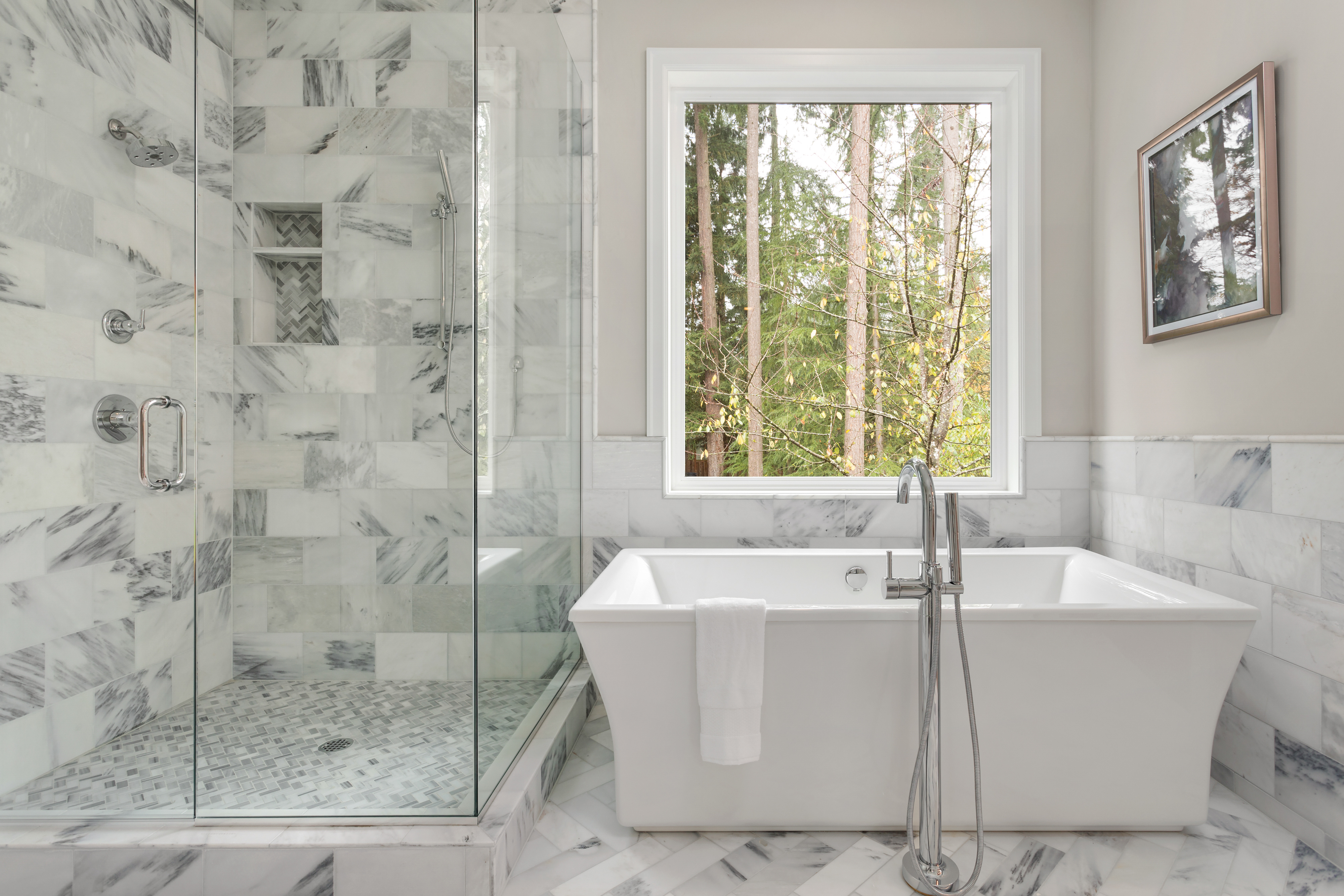
Bathroom tile that lasts is chosen for three things a looks-first shopper skips: how well the material handles water, how much grip it has underfoot when wet, and how its grout and sealing hold up over years of showers. Get those right and almost any style will still look good a decade in. Get them wrong and a beautiful bathroom starts leaking, staining, or turning into a slip hazard within a few seasons. The finish you fall for on the sample board is the easy part.
The choices that actually decide durability shift by room and by climate, which is why our tile selection starts with where the tile is going before what it looks like. Our guide to tile covers the material in general; this is the wet-room version, aimed at Denver bathrooms and the hard water they run.
Porcelain, Ceramic, or Natural Stone: Which Handles a Wet Room?
Porcelain is the most water-resistant of the common bathroom tiles, followed by ordinary ceramic, with natural stone the most demanding to keep sealed. Porcelain is fired denser and harder than standard ceramic, so it absorbs very little water and shrugs off a wet floor, which is why it's the safe default for shower walls, shower floors, and bathroom floors alike. Ceramic that isn't porcelain is more porous and a little softer, which is fine on walls and in lower-traffic spots but a weaker choice underfoot in a shower. Natural stone like marble or travertine is genuinely beautiful and genuinely porous, so it can go in a bath, but only with regular sealing and an eye on where water sits.
Material | Water resistance | Best use in a bathroom | Upkeep |
|---|---|---|---|
Porcelain | Very low absorption, dense | Shower walls and floors, bath floors | Low; grout is the weak point |
Ceramic (non-porcelain) | More absorbent, softer | Walls and lower-traffic areas | Low; avoid heavy wet-floor use |
Natural stone | Porous | Walls and accents; floors with care | Needs periodic sealing |
The takeaway for most Denver bathrooms is to lean porcelain where water lands and save ceramic or stone for the drier, decorative work. A porcelain floor and shower pan with a stone or ceramic accent wall gets the durability where it matters and the look where it shows.
Why Slip Resistance Matters Most on a Bathroom Floor
Slip resistance is the specification that turns a good-looking bathroom floor into a safe one, and tile is rated for it. Hard-surface flooring carries a slip-resistance classification under ANSI A326.3, the American national standard that measures a tile's dynamic coefficient of friction, which is the grip it offers a foot that's moving across it. The number matters because a wet bathroom floor is one of the most common places people fall at home, and the tile that feels grippy dry can be dangerous wet.
The practical move is to ask for a tile's wet slip rating and choose one classified for a level interior floor walked on when wet, rather than a wall or dry-area tile pressed into service on the floor. Texture helps too: a matte or lightly textured finish grips better than a high-gloss one, and on a shower floor smaller tiles with more grout lines give the foot more to hold. A polished marble that dazzles on a wall can be a skating rink on a shower pan, so the floor and the walls often want different tiles for good reason.
Grout and Sealing: The Part of a Tiled Shower That Fails First
Grout, not the tile, is usually the first thing to fail in a shower, so how it's chosen and sealed decides how long the whole wall lasts. Standard cement grout is porous, which means it soaks up water and staining unless it's sealed and re-sealed over time, and it's where mildew and discoloration show up first. Epoxy grout costs more and is fussier to install, but it's essentially waterproof and stain-resistant, which makes it worth the upgrade in a shower that sees daily use. The tile can be flawless and the shower can still fail at the joints if the grout was the afterthought.
Sealing follows the material. Glazed porcelain and ceramic have a hard, non-porous face that doesn't need sealing, though cement grout between them still does. Natural stone needs sealing on the whole surface, not just the joints, and it needs it again on a schedule, because the day the sealer wears through is the day water and soap start working into the stone. Knowing which parts of your bathroom need sealing, and how often, is half of keeping it looking new.
How Denver's Hard Water Changes Your Tile Choice
Denver's hard water is a real factor in how a bathroom looks over time, and it should nudge a few tile decisions. Denver Water, the utility for the metro area, classifies its supply as soft to moderately hard, and by the U.S. Geological Survey scale water is soft below 60 mg/L of calcium carbonate, moderately hard up to about 120 mg/L, and hard from 121 to 180 mg/L. Water in that moderately hard range carries dissolved minerals that dry into the chalky white scale you see on shower glass and fixtures, and it settles into porous surfaces fastest.
The mineral load in that water is an argument for easy-clean, low-porosity choices in a Denver shower. A dense glazed porcelain wipes clean where a porous stone holds scale and needs more coaxing. Sealed or epoxy grout resists the mineral staining that untreated cement grout collects. And larger tiles with fewer grout lines simply give hard water fewer seams to work into. None of it makes stone off-limits; it just means stone in a Denver bath comes with a cleaning and sealing routine you should plan for going in.
Wall Tile and Floor Tile Aren't Interchangeable
Wall tile and floor tile are rated for different jobs, so using one where the other belongs is a mistake worth avoiding. Floor tile is made harder and thicker to take foot traffic and to meet a wet slip rating, while many wall tiles are thinner, softer, and glazed for looks rather than grip. A wall tile can go on a floor only if it's also rated for floor and wet use, and a lot of pretty wall tiles are not. Floor tile can usually go on a wall, so when in doubt, a floor-rated porcelain is the flexible choice. The label or the spec sheet tells you which uses a tile is approved for, and it's worth reading before you fall for a sample.
Large-Format Tile or Small Mosaics in a Shower?
Large-format tile and small mosaics each have a place in a shower, and the split usually falls between the walls and the floor. Large tiles on shower walls mean fewer grout lines, which means less grout to seal and clean and a cleaner, more continuous look, and they suit Denver's hard water by giving mineral scale fewer seams to collect in. Shower floors are the opposite case: they have to slope to the drain and stay grippy underfoot, and small mosaic tiles flex to that slope while their many grout lines add traction right where you need it. A common, durable combination is large-format porcelain on the walls and a matching mosaic on the shower floor.
Bathroom Tile Questions Denver Homeowners Ask
Is porcelain or ceramic tile better for a shower?
Porcelain is the better choice for a shower because it's denser and absorbs far less water than ordinary ceramic. That low absorption makes it reliable on shower walls and floors that stay wet, where a more porous ceramic is a weaker pick. Ceramic is perfectly good for a dry accent wall or a lower-traffic bathroom, so both can appear in the same room in different roles.
What tile is best for a shower floor?
The best shower-floor tile is a slip-rated porcelain or a mosaic, because a shower floor has to grip wet feet and slope to the drain. Small mosaic tiles handle the slope and add grout lines that improve traction, and any floor tile you choose should carry a wet slip-resistance classification. A glossy tile made for walls is the wrong call underfoot.
Does shower tile need to be sealed?
Glazed porcelain and ceramic tile don't need sealing, but the cement grout between them does, and natural stone needs sealing across its whole surface. Sealing keeps water and soap out of porous materials, and it wears off over time, so grout and stone need resealing on a schedule. Epoxy grout is one way to skip most of the grout-sealing upkeep.
How do I keep hard water off my shower tile?
Keeping hard-water scale off shower tile in Denver comes down to low-porosity surfaces and regular wiping. A dense glazed porcelain and sealed or epoxy grout resist mineral buildup better than porous stone and raw cement grout. A quick squeegee after showers and larger tiles with fewer seams both cut down where scale can settle in the first place.
Can I use the same tile on the shower walls and floor?
You can use the same tile on shower walls and the floor only if it's rated for floor and wet use, which many decorative wall tiles are not. A floor-rated porcelain can run up the walls with no problem, so matching from the floor up is the safer direction. On the shower floor specifically, a smaller format is easier to slope to the drain even when the walls go large.
What bathroom tile is easiest to keep clean?
Large-format glazed porcelain with sealed or epoxy grout is the easiest bathroom tile to keep clean, especially in Denver's hard water. The dense glazed face wipes down without holding scale, and fewer, sealed grout lines give minerals and mildew less to grab. Porous natural stone looks superb but asks for the most upkeep of the common choices.
Choosing Bathroom Tile With Roomscape
The right bathroom tile is the one matched to where it's going, how wet it gets, and the water it has to live with, and that's easier to judge with samples in hand. Our team has helped Denver-area homeowners choose and install tile for more than three decades, and we can bring samples to your home so you can see a finish against your own light and fixtures, or you can look through finished bathrooms in our project gallery. When you're ready to plan yours, request a free in-home estimate and we'll walk through materials, slip ratings, and grout for your space.

