

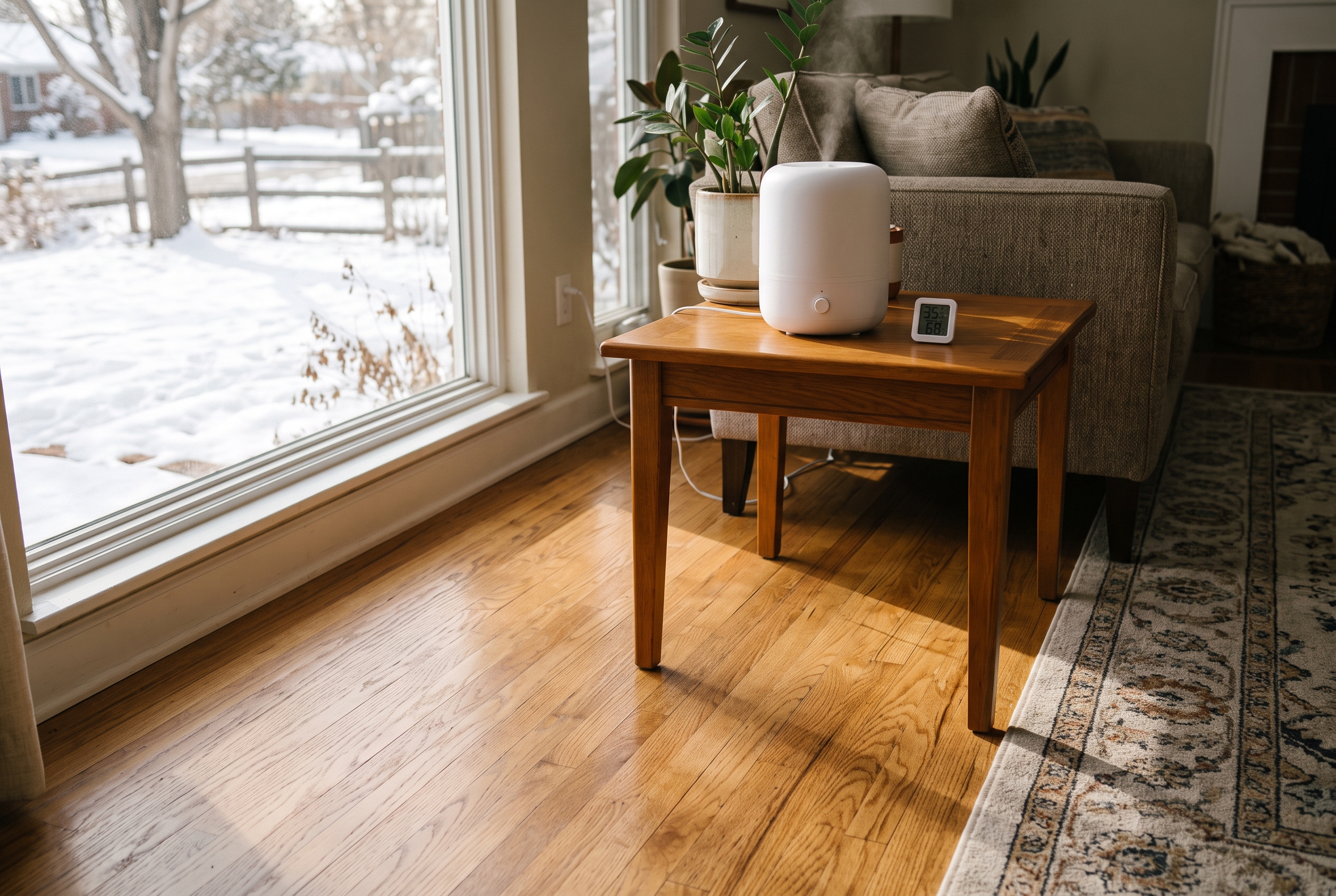
Yes, most hardwood floors in a heated Colorado home need a humidifier's help from about October to April. Left alone, a Front Range house in January sits in the teens. That's far below the 30 to 50 percent humidity wood flooring is made for, so solid boards shrink and open thin gaps at the seams, and gaps like that which close again by summer are normal. Engineered floors and tight newer houses need less help, and in summer a swamp cooler can push the same floor the other way.
| Your floor | In a heated Front Range winter | What to aim for |
|---|---|---|
| Solid oak, maple or hickory strips | Shrinks; thin gaps at the seams | Humidifier; 35 to 40 percent |
| Wide-plank solid wood | A wider gap at every seam | Humidifier; 35 to 40, held steady |
| Engineered hardwood | Moves far less; can check if very dry | Its maker's range, often 35 to 55 |
| Laminate | Fiberboard core still reacts | Its maker's range |
| Luxury vinyl plank | No wood to shrink | No humidifier needed for the floor |
What Humidity Hardwood Floors Need
Hardwood floors are made to live at about 30 to 50 percent relative humidity and 60 to 80 F. That's the range the National Wood Flooring Association (NWFA) gives for a home once the floor is in. Provenza, one of the hardwood makers we carry, asks for a little more: 35 to 55 percent at 65 to 85 F, all year, even when nobody is home.
When the maker's number is stricter than the association's, follow the maker. The care guide that came with your floor is the one its warranty reads, and most hardwood warranties treat damage from a house kept outside the range as excluded. They also treat some seasonal shrinking and swelling as normal wood behavior. A hygrometer in the room, checked through the winter, is the simplest record that you held up your end.
The range comes from the wood itself. Wood takes on or gives up water until it matches the air around it. Air at 30 to 50 percent holds a floor at roughly 6 to 9 percent moisture, which is about where flooring is dried at the mill. Drop the room to 15 percent and the same boards head toward 3 or 4 percent, and every point they lose shows up as a little less width.
You'll find pages that recommend 50 to 70 percent for wood floors. In a Denver winter that would sweat the windows long before the floor noticed, and no home should be humidified past 50 percent anyway. For most Front Range houses, the practical target is 35 to 40 percent through an ordinary winter, turned down on the coldest nights.
Why Dry Air Opens Gaps Between Boards
Dry air opens gaps between boards because wood shrinks across its width as it dries, while its length barely changes. Every board gets a little narrower, and the difference collects at the seams. A 5-inch flat-sawn red oak board going from a summer 9 percent moisture to a winter 5 percent loses about a sixteenth of an inch of width. That's roughly the thickness of a dime, repeated at every seam in the room.
How much a floor moves depends on the boards. Wider boards open wider gaps, because the movement is proportional to the width. Flat-sawn boards move about twice as much as quartersawn or rift-sawn ones, since wood shrinks about twice as much along its growth rings as across them. Hickory and maple shrink more than red oak for the same drop in moisture, so they need the humidity routine more than most.
The movement reverses on its own. When spring air comes back and the furnace rests, the boards take up moisture and the gaps close, usually by early summer. A humidifier's job is to keep that yearly swing small enough that you don't notice it.
How Dry a Colorado House Gets in Winter
A heated Colorado house gets far drier in winter than you might expect, because cold air holds very little water. On an average January day here, the outdoor air is near freezing. Warm that same air to 70 degrees inside and its relative humidity lands around 15 percent. Showers, cooking and breathing add a little back, but a furnace running most of the day keeps pulling it down.
Your house sets how far it falls. Older Denver bungalows, ranches and Tudors leak air around windows, doors and the attic, and every cubic foot of cold air that leaks in arrives bone dry once it's heated. In a leaky house during a below-zero spell, indoor humidity can settle under 10 percent. Newer homes built tight, often with a ventilation system that trades air slowly, hold more of the moisture a household makes and may sit in the 20s or 30s on their own.
The dry season here runs from the first steady furnace use in October to the last cold nights in April. The driest weeks are usually January and February, when the furnace runs longest. Measuring your own rooms is the only way to know where your house sits.
How to Tell if Your Floor Needs a Humidifier
A week of hygrometer readings tells you whether your floor needs a humidifier, and which kind. Digital hygrometers are inexpensive and sold at most hardware stores, and many show the temperature too.
- Put the hygrometer in the room with the wood floor, at about table height. Keep it away from the kitchen, bathrooms, heat registers, exterior doors and windows.
- Give it a day to settle once the furnace is running steadily.
- Read it every morning and evening for a week, and jot down the outdoor temperature beside each reading.
- Compare. Readings that hold at 35 percent or higher mean you don't need a humidifier yet. Readings that dip into the 20s on cold nights call for a room humidifier or a whole-house unit at a modest setting. Readings in the teens for days call for a whole-house system.
- Check the floor at the same time. Thin dark lines usually show first along seams near heat registers and in sunny rooms.
Leave the hygrometer where it is once you add humidity. It's how you'll set the humidifier, how you'll know when to turn it down for a cold snap, and how you'll know when to shut it off in spring.
Are Winter Gaps in Hardwood Floors Normal?
Yes, thin, even gaps at many seams between December and March are normal in solid wood, as long as they close by early summer. Nearly every wood floor shows some seasonal separation in the dry months. On a narrow board, a winter gap about the thickness of a dime is ordinary; wide planks open a wider gap at each seam because each one has more wood to lose.
| What you see | What it usually means | What to do |
|---|---|---|
| Thin, even gaps at many seams in winter | Normal seasonal shrinking | Raise humidity; wait for spring |
| A wide gap every few boards | Boards bonded by finish move as one | Humidity now; repair at a refinish |
| Gaps still open in July or August | Wood too wet or too dry when laid | Measure wood moisture before repairs |
| Board edges higher than centers | Moisture under the floor (cupping) | Find and stop the water first |
| Fine cracks along board faces | Checking from very dry air | Raise humidity; follow the care guide |
A wide gap every few boards, with tight seams between, has its own cause. On a site-finished floor, the finish sometimes glues a few boards together at their edges, and that group shrinks as one wide board. Instead of five thin gaps you get one wide one. It looks worse than it is, and the answer is the same humidity routine.
Gaps lag the air by weeks. Once the room holds 35 percent, give the boards a few weeks to swell back, and expect the last of the gap to close only when spring brings real humidity. Gaps still open in the middle of summer are the ones to measure. The moisture in the wood and in the subfloor shows whether the boards went in wetter or drier than the house they live in, and that reading comes before anything is filled or sanded.
Should You Fill Winter Gaps in Hardwood?
No, seasonal gaps shouldn't be filled. Filler packed into a winter gap gets squeezed out or crushed when the boards swell in summer. Then it cracks and drops out the next winter, leaving a dirty seam that looks worse than the gap did.
Gaps that stay open through a full humid summer are different, and filler isn't the fix for them either. Flooring contractors glue thin slivers of matching wood to the edge of a board in each gap, then sand and finish the floor, so the new wood moves with the old. That's refinishing work, done once the floor has been held at steady humidity long enough to show its true size.
Whole-House Humidifier or Room Humidifiers
If your wood runs through the main level and you have a forced-air furnace, a whole-house humidifier is the steadier choice. It mounts on the furnace and treats every room the floor is in at once. If the wood is in one or two rooms, or your heat comes from a boiler, baseboards or radiant floors with no ducts, room humidifiers do the job with more daily attention.
Whole-house units come in three kinds. A bypass unit uses the furnace blower to push warm air through a wet pad and back into the ducts; it's the simplest and puts out the least. A fan-powered unit has its own fan, so it delivers more moisture from the same pad. A steam unit boils water and sends the steam into the ducts, so it keeps working when the furnace isn't heating and has the most capacity.
Steam matters most in a large or leaky house during the coldest weeks. Each type is built for a different home size and zoning, so the right one depends on your square footage and how many heating zones the house has.
| Type | How it works | Best for |
|---|---|---|
| Bypass (whole-house) | Furnace air through a wet pad | Smaller, tighter homes |
| Fan-powered (whole-house) | Its own fan through a wet pad | Average homes; more output |
| Steam (whole-house) | Boils water into the ducts | Large or leaky homes |
| Evaporative room unit | A fan through a wet wick | One or two rooms; no white dust |
| Ultrasonic room unit | Vibrates water into a fine mist | Quiet bedrooms; distilled water |
Room units each have a trade-off. Evaporative models can't push a room past what the air will absorb, so they're hard to overdo, and their wick traps minerals. Ultrasonic models are quieter but spray the minerals in tap water into the air as fine white dust. Warm-mist models boil the water, which keeps them clean but makes them a burn risk around children and pets.
What Size Humidifier a Hardwood Floor Needs
Humidifiers are sized by how many gallons of water they put into the air each day, and a whole floor needs more than most units on a store shelf. To hold 35 percent with 20 degrees outside, a 2,000-square-foot house needs roughly 6 1/2 gallons a day if it's tightly built. An average house that size needs about 11, and an older, leaky one about 16. At 1,500 square feet, the figures are roughly 4 1/2, 8 and 12.
That's why one tabletop unit does little for a floor that runs through the main level. A model that puts out a gallon or two a day humidifies the room it sits in, with the door closed. For a whole floor, size the humidifier by square footage and by how tight the house is; a leaky older home needs about two and a half times the output of a tight one.
There's no need to size for the worst night of the year. When it's far below zero, the windows force a lower setting anyway, so a unit that holds 35 percent in ordinary winter weather is big enough for a floor.
Running a Room Humidifier Without Hurting the Floor
A room humidifier helps a wood floor only if it never drips on it and never pushes the room too high. The EPA's guidance for portable units covers most of the routine.
- Set it on a table or a stand with a tray under it, never directly on the wood, and keep it a few feet from walls and furniture.
- Empty, dry and refill the tank every day.
- Clean it every third day, scrubbing off scale and film, and rinse it well if you used a cleaner.
- Fill an ultrasonic or impeller unit with distilled water.
- Run it on its humidistat or against your hygrometer, and never past 50 percent.
Each step protects the finish as much as the air. Standing water and drips leave white rings and can swell the edges of boards. Tap water in an ultrasonic unit settles on the floor as a gritty white film. And a room held past 50 percent invites mold on cold walls and windows long before the floor needs that much.
What a Humidifier Costs to Buy and Run
Nationally, a whole-house humidifier costs about $580 installed on average, with most jobs between about $390 and $770. Those are HomeAdvisor's figures, from a survey of more than 30,000 homeowners' project costs. The unit alone runs about $100 to $300 for a drum-style bypass model, $200 to $600 for a flow-through model and $300 to $1,100 for steam.
| Option | Up front | Each year |
|---|---|---|
| Bypass or flow-through, installed | About $390 to $770 typical | A $10 to $50 pad |
| Steam, installed | Unit $300 to $1,100, plus labor | About $150 to $500 to run |
| Room units | Far less than whole-house | Distilled water, wicks, daily care |
The cheapest unit isn't always the cheapest to own. Drum-style models cost the least but hold standing water, so they need frequent cleaning and carry more risk of mold. Flow-through models cost more and use more water, because the water runs through the pad and drains away, but they need less upkeep. Steam units cost the most to buy and to run, and they keep up best in the coldest weeks.
What moves the installed price is the type, the size of the house, local labor rates and how much work the job takes, such as running a water line or adding a circuit for steam. A well-kept unit lasts 10 to 15 years, so the typical $580 job works out to roughly $40 to $60 a year before pads, and repairs, when they come, average about $230. A heating contractor installs it on the furnace, and it's worth choosing a model whose control can take an outdoor temperature sensor for the coldest nights.
How High to Set It When It's Below Zero Outside
When an Arctic front drops Denver below zero, turn the humidifier down, because the windows set the ceiling before the floor does. The University of Minnesota's extension engineers explain that the highest humidity a house can hold without window condensation falls as the outside temperature drops. They put a reasonable level for below-zero weather at about 20 percent.
| Outside temperature | Highest indoor humidity |
|---|---|
| 20 to 40 F | About 40 percent |
| 10 to 20 F | About 35 percent |
| 0 to 10 F | About 30 percent |
| -10 to 0 F | About 25 percent |
| -20 to -10 F | About 20 percent |
Those figures assume 70 degrees inside and double-pane windows. Closed blinds and heavy drapes make the glass colder, so set it a little lower in rooms where they're drawn at night. Water running down the glass and pooling on the sills is the sign you're too high for the weather.
A few days under the floor's range during a cold snap does it no harm. Wood changes slowly, and short swings mostly touch the surface; wet sills and mold in the window frames are the real risk. A humidistat with an outdoor sensor lowers the target on its own as the temperature falls. Without one, check the windows on cold mornings and turn the setting down until the condensation stops.
Summer Cupping and Swamp Coolers
Summer cupping, where your boards' edges sit higher than their centers in July or August, means the underside of the floor is wetter than the top. In a dry state like ours, that water usually comes from a swamp cooler running with too little exhaust, a damp crawlspace or basement, a leak, or a stretch of humid monsoon weeks.
Swamp coolers are the Front Range's own cause. A direct evaporative cooler cools by adding water to the air, so it raises indoor humidity. The Department of Energy's building guidance says doors or windows have to be open to give that air a way out. It sets about 2 square feet of opening for every 1,000 cubic feet per minute of cooler airflow, and the cooler's rating is on its label. Run a cooler in a closed-up house and a floor that spent the winter shrinking spends the summer swelling.
- Put the hygrometer back in the room. Summer readings past 55 percent, the top of most hardwood ranges, mean the cooler needs more exhaust.
- Open the relief windows the cooler needs on the downwind side, or have ceiling relief vents added so you don't have to.
- Run the cooler only when it's needed, and switch to air conditioning or a dehumidifier in humid monsoon spells.
- Check the crawlspace or basement for standing water, wet soil or a leaking line.
- Wait. Once the water source is gone, most cupped floors flatten as they dry.
Don't sand a cupped floor flat. If the raised edges are sanded off while the boards are still wet underneath, the boards dry later and end up crowned, higher in the middle than at the edges. A floor is sanded only when the moisture at the top and the bottom of the boards is within about a percent. Boards lifting right off the subfloor are buckling, a different emergency, and they always mean water that has to be found and dried at once.
Engineered Hardwood, Laminate and Vinyl Plank in a Dry House
Engineered hardwood needs far less help than solid wood in a dry winter, though it isn't immune. Its real wood top sits on layers of plywood or composite laid crosswise, and engineered hardwood's crossed layers move far less than solid wood at our altitude. Its maker still sets a humidity range. In a house that sits in the teens all winter, the top layer can still shrink, and the board's face can cup slightly or show fine checks.
Laminate has a fiberboard core where solid wood would be, and that core still reacts to humidity, so laminate's installation guidelines set conditions for the room too. Luxury vinyl plank has no wood to shrink, so a dry winter won't open gaps in it the way it does in oak. Its makers mostly set temperature limits, and Provenza writes humidity control into the warranty for its vinyl plank as well as its hardwood.
If you'd rather not run a humidity routine at all for the floor's sake, the floors that fit are the vinyl plank in our catalog. For real wood with the least seasonal movement, it's engineered.
Hardwood Over Radiant Heat
Radiant floor heat makes the humidity routine matter more, because the heat dries the boards from underneath while the furnace dries the room. Engineered hardwood is the usual choice over radiant heat, and it comes with firm limits.
Provenza caps the floor surface at 85 F for its engineered oak, says anything hotter damages the floor and voids the warranty, and wants the system to warm gradually with the weather, in small steps. Because radiant heat lowers indoor humidity, it also asks for a humidifier on the HVAC system to hold 35 to 55 percent.
In practice, get the humidity up before the heating season starts in earnest. Then let the radiant system come up slowly in the fall, so the first cold night isn't the night it jumps to full heat.
Installing a New Hardwood Floor in a Dry Climate
A new hardwood floor goes in best when the house is already at the temperature and humidity it will live at, with the heat on and the humidifier running before the boxes arrive. Wood laid at living conditions has the least distance to move once you move in.
- Bring the house to living conditions first: heat at its normal setting, the humidifier holding the range, drywall and paint dry.
- Let the cartons sit in the rooms where they'll be installed. Provenza asks for at least five days in normal, climate-controlled conditions.
- Measure the moisture; the days alone don't settle it. The wood should be within 4 percentage points of the subfloor's moisture before installation starts, the limit the NWFA sets as well.
- Keep the readings with the floor's paperwork, and keep the conditions for the life of the floor.
Installing in the heating season is fine on those terms. Trouble comes from wood laid in a house that's far drier or wetter than it will be in normal use, such as a remodel with the heat off or fresh drywall mud still drying.
A Year With a Hardwood Floor on the Front Range
A hardwood floor's year on the Front Range follows the furnace and the cooler, and the whole routine fits on a sticky note by the thermostat.
- October: replace the humidifier pad or clean the room units, and set 35 to 40 percent as the furnace starts running steadily.
- November to February: lower the setting for cold snaps and check the windows on cold mornings.
- March and April: taper the humidifier as the days warm and the furnace runs less.
- May to September: humidifier off; give a swamp cooler its exhaust and switch to air conditioning in humid spells.
Choosing a Wood Floor for a Dry House
If you're choosing a wood floor for a house that runs dry, engineered construction, narrower boards and a stable cut give you the least seasonal movement. Engineered wood suits Denver's swings because its layers resist shrinking. Solid hardwood can be sanded and refinished many times, which is its strength over decades, and it asks for the steadiest humidity in return.
Board width, cut and species make the rest of the difference. Narrower boards spread the movement over more seams, so each gap is smaller. Quartersawn or rift-sawn oak moves about half as much as flat-sawn. Oak is the steadiest of the common species, while hickory and maple are harder but move more. A matte, wire-brushed or hand-scraped finish hides a seasonal line far better than a glossy one.
Our hardwood catalog carries both engineered and solid floors, from makers including Provenza, Portercraft, DuChateau, Fabrica and DH Floors. Light changes how any wood looks, so we bring samples right to your front door and you judge them on your own floor before you choose.
Hardwood Floors From Roomscape Studios
At Roomscape Studios, we sell and install hardwood floors for homes across Denver, Arvada, Boulder, Littleton and Broomfield, and the floor you choose from us is the one our installers put down. That means one team answers for the wood, the measure and the work.
When you're ready, one of our project specialists comes to your home for a free estimate and measures the rooms before you settle on a floor. Our design studio is at 5180 Fox St., Suite 63, in Denver.
Hardwood Floor Humidity Questions
Can a Humidifier Damage Hardwood Floors?
Yes, but only when it's misused. The usual culprits are a humidifier that drips or sits right on the wood, a room pushed past 50 percent so the boards swell, and an ultrasonic unit on tap water that coats the finish in white mineral dust.
Set on a stand, filled with distilled water and run against a hygrometer, a humidifier is one of the best things you can do for a wood floor in a Colorado winter.
What About a House That Sits Empty Part of the Winter?
A house that sits empty dries out faster than a lived-in one, because nobody is showering or cooking. Leave the heat at a normal setting and the humidifier on its humidistat while you're away.
The humidity range a hardwood warranty asks for applies when the house is empty too, and a second home in the mountains is where it's most often skipped.
Can You Set the Humidifier Higher to Close Gaps Faster?
No. Setting the humidifier past the window ceiling for the weather only sweats the glass, and the boards won't swell any faster, because wood takes up moisture over weeks.
Hold the room at 35 to 40 percent, lower it for cold snaps, and give the floor the rest of the winter. The gaps close on the wood's schedule.
Getting Your Floor Ready for Winter
The cheapest protection a wood floor has is a hygrometer in the room this week, before the furnace runs all day, and a humidifier set to the number it shows. And if your current floor is due for replacing, or you're picking wood for a house that runs dry, book a visit and a project specialist will measure your rooms and bring floors that suit them.

