

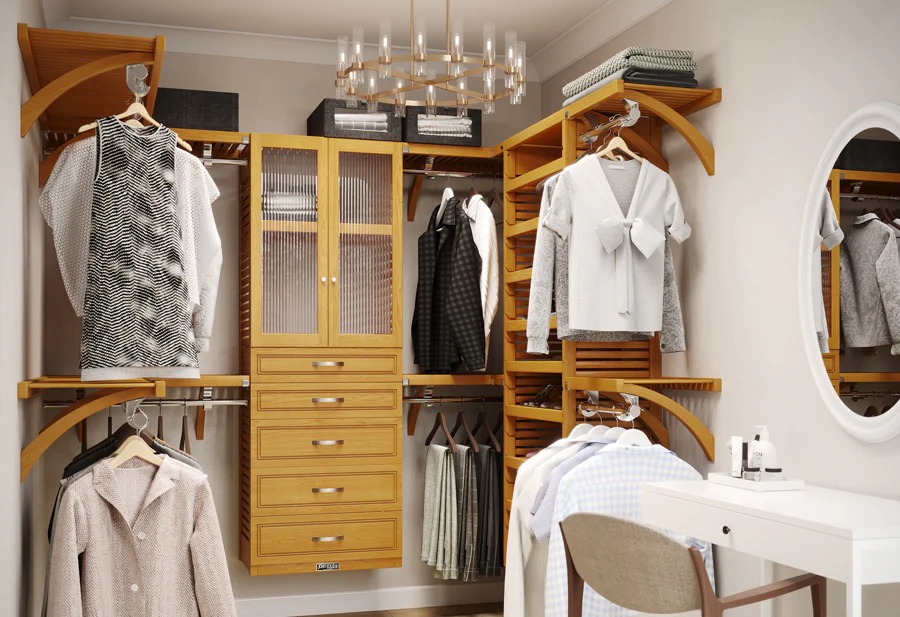
Whether a custom closet is worth it depends on what the room asks of it. For a small, square reach-in with a simple job to do, a big-box kit is honest value. For a closet with odd walls, real storage demands, or a decade or more of daily use ahead of it, a custom system usually earns the difference back in fit, sturdier materials, and the years it keeps working. The trick is knowing which situation you're in before you spend.
The honest comparison comes down to four things: what drives the cost, how the two are built, how long each lasts, and what the space is worth to you and the next owner. Here's how they stack up, and where a kit is genuinely the smarter buy. When a project crosses into custom, that's the work our closet design team does day to day.
What Separates a Custom Closet From a Big-Box Kit?
A custom closet is designed and built to one specific room and wardrobe, while a big-box kit is a set of standard-size parts you buy off the shelf and fit yourself. A kit gives you rods and shelves in common widths, usually wire or thin laminate, hung on the wall with brackets. A custom system is measured to the exact walls, built from furniture-grade panels, and configured with the mix of drawers, rods, and shelving the room actually needs. Everything downstream of that difference follows from it: cost, materials, and how long the closet lasts.
There's a middle option worth knowing about. Semi-custom systems come in modular pieces you combine and sometimes install yourself, landing between a fixed kit and a fully bespoke build. They fit a bit better than a basic kit and cost less than full custom, and they're a fair compromise when a closet is close to standard but not quite.
What Drives the Cost of a Custom Closet?
The cost of a custom closet is driven by size, materials, accessories, and installation rather than a single sticker price. The bigger the closet and the more linear feet of storage, the more material and labor it takes. Solid drawer boxes, soft-close hardware, pull-out racks, and integrated lighting each add cost over plain open shelving. And the installation itself, measuring, scribing panels to out-of-square walls, and mounting a system that carries real weight, is where a custom job separates from a kit you screw into drywall over a weekend.
A kit's price is mostly the parts, because you supply the labor. That's the real trade behind the lower number: a kit costs less up front and asks for your weekend and your tolerance for a layout someone else drew. Because those drivers swing the total so much, an honest closet price comes from seeing the room rather than reading off a catalog, which is why a measured quote beats a ballpark every time.
Custom vs. Kit: The Honest Comparison
A custom system and a big-box kit trade upfront cost against fit, materials, and how long they last, and laid side by side the pattern is clear. Neither is the right answer for every closet; the table below is really a way to find your own situation in the bottom row.
Factor | Big-box kit | Custom system |
|---|---|---|
Upfront cost | Lower | Higher |
Fit to the room | Standard sizes, trimmed on site | Built to the exact walls |
Materials | Wire or thin laminate | Furniture-grade panels |
Reach and layout | Fixed shelf and rod heights | Set to your reach and wardrobe |
Installation | DIY into drywall | Measured and professionally installed |
Lifespan | A few years of daily use | Often decades |
Best for | Simple square reach-ins, rentals, tight budgets | Odd rooms, heavy daily use, a long horizon |
The "best for" row is the whole decision. We wrote about how a design studio and a big-box store differ, and a closet is the clearest small example: the same wall, two very different ways of filling it.
Do the Materials Actually Differ?
The materials differ in two ways that matter: how much weight they hold and what they give off. A custom system is usually built from furniture-grade panels, thicker engineered wood that holds a screw and carries a loaded shelf without bowing, while many kits use thin laminate over particleboard or coated wire that sags under a season's worth of clothes. On a wall of hanging clothes, that load rating is the difference between a shelf that stays put and one that dips in the middle within a year.
The health dimension is the part most closet comparisons skip. Engineered-wood panels, hardwood plywood, medium-density fiberboard (MDF), and particleboard, give off small amounts of formaldehyde, and in the United States they're regulated for it. The U.S. Environmental Protection Agency (EPA), the federal agency that sets national limits on pollutants, caps those emissions under Title VI of the Toxic Substances Control Act (TSCA), the law that governs chemicals in everyday products, and it aligned those caps with California's stricter rules to cut what a household breathes indoors. For a closet, the takeaway is simple: ask what the panels are and whether they meet the current formaldehyde standard. A reputable custom shop can answer that for its materials, and a bargain kit often can't, which is one more reason seeing a real sample matters. We can bring finish samples to your home so you can judge the panel and the hardware in your own light.
How Long Does Each Closet Last?
A custom closet built from furniture-grade panels and anchored into framing commonly lasts for decades, while a wire or thin-laminate kit is doing well to give a few years of daily use before a shelf sags or a bracket pulls out of the drywall. Lifespan tracks with panel thickness, hardware quality, and whether the system was fastened to studs rather than just wallboard. A closet that stays square and level for the life of the house is cheaper per year than one replaced twice in the same span, even though it costs more on the first day.
Does a Custom Closet Add Value to Your Home?
A well-built, organized closet adds everyday value and supports resale, though it isn't the kind of upgrade that returns a fixed percentage the way a kitchen or bath remodel is measured. Buyers prize storage: the National Association of Home Builders (NAHB), the trade group that surveys new-home buyers every year, found in its 2024 study that a dedicated laundry room was the single most-wanted feature, named by 86 percent of buyers. Functional, organized storage is exactly what a custom closet brings to the bedroom, and it shows the day a house goes on the market.
The bigger return is daily. A closet where everything has a place and sits in the reach zone, between 15 and 48 inches off the floor by the standards the federal Access Board publishes, saves a few minutes every morning and keeps clothes in better shape. Custom systems also respect the way rooms are built, protecting the 30-by-48-inch clear floor space you need to stand and use a run of storage and, in a walk-in, a 60-inch turning circle that a wall of kit shelving quietly eats into. You can see how finished projects come together in our project gallery.
When a Big-Box Kit Is the Smarter Buy
A big-box kit is the right call more often than a custom shop will admit. If the closet is a small, square reach-in with straight walls, a kit fits it fine and there's no reason to spend more. If you're outfitting a rental or a starter home you plan to leave in a couple of years, the lower upfront cost is the sensible choice. And if you enjoy the project and own the tools, a kit is a satisfying weekend job. The case for custom gets strong when the room fights back, with odd angles, a sloped ceiling, or a walk-in worth planning, and when you'll live with the closet long enough that fit and lifespan outweigh the first receipt.
Custom Closet Questions Denver Homeowners Ask
Are custom closets worth the money?
Custom closets are worth the money when the room is complicated or you'll use it hard for years, and less so for a simple square reach-in. The value sits in the exact fit, the sturdier furniture-grade materials, and a lifespan measured in decades rather than seasons. For a straightforward closet on a tight budget, a kit is honest value and nothing to apologize for.
How much more does a custom closet cost than a kit?
A custom closet costs more than a kit because you're paying for measured design, furniture-grade materials, and professional installation instead of supplying the labor yourself. Rather than a fixed multiple, the gap depends on the closet's size, the accessories you choose, and how out-of-square the walls are. The reliable way to know your number is a measured quote for your actual space.
Do custom closets add resale value?
Custom closets support resale by giving buyers the organized storage they rank near the top of their wish list, though they don't return a fixed percentage the way a major remodel is scored. NAHB's national buyer survey shows how much weight buyers put on functional storage and utility space. The larger payoff is the daily use you get from it while you live there.
Are custom closet materials better or safer?
Custom systems are usually built from thicker, furniture-grade panels that hold weight better than the wire or thin laminate in most kits, and a reputable shop can confirm its panels meet the federal formaldehyde standard for composite wood. That standard, set by the EPA under the Toxic Substances Control Act, caps how much formaldehyde engineered-wood panels can emit. It's a fair question to ask whatever you buy.
Can I install a custom closet system myself?
You can install many semi-custom systems yourself, but a fully custom closet is designed to be measured and installed by the shop that built it, because the panels are scribed to your walls and anchored to carry real weight. That installation is part of what you're paying for and part of why it lasts. A basic kit, by contrast, is built to be a do-it-yourself job.
Is a custom closet better than hiring a professional organizer?
A professional organizer rearranges what your closet already has, while a custom closet changes what the closet is. If your storage works and is only messy, an organizer is the cheaper fix. If the closet itself is the problem, with wrong heights, wasted corners, or too little of the right storage, organizing the box won't solve it and a custom system will.
Deciding on Your Closet With Roomscape
The worth-it question is easiest to answer with the room in front of you. Our designers have planned closets for Denver-area homes for more than three decades, and the first step is always the same: see the space, hear how you use it, and lay out honest options, custom or not. When you're ready to weigh yours, request a free in-home estimate and we'll measure the closet, talk through materials and layout, and price a system built to fit it.